Showing posts with label Java. Show all posts

Wednesday, June 20, 2018

Chargeback in the Cloud - The Movie

If you were unable to attend the live presentation on cost-effective defenses against chargeback in the cloud, or simply can't get enough performance and capacity analysis for the AWS cloud (which is completely understandable), here's a direct link to the video recording on CMG's YouTube channel.

The details concerning how you can do this kind of cost-benefit analysis for your cloud applications will be discussed in the upcoming GCAP class and the PDQW workshop. Check the corresponding class registration pages for dates and pricing.

Saturday, April 21, 2018

Virtual cloudXchange 2018 Conference

Our abstract has been accepted for presentation at the FREE cloudXchange online event to be held by CMG on June 19th at 10am Pacific (5pm UTC). [Extended slides]

Exposing the Cost of Performance
Hidden in the Cloud


Neil Gunther
Performance Dynamics, Castro Valley, California

Mohit Chawla
Independent Systems Engineer, Hamburg, Germany

10am Pacific Time on June 19, 2018

Whilst offering lift-and-shift migration and versatile elastic capacity, the cloud also reintroduces an old mainframe concept—chargeback—which rejuvenates the need for performance analysis and capacity planning. Combining production JMX data with an appropriate performance model, we show how to assess fee-based EC2 configurations for a mobile-user application running on a Linux-hosted Tomcat cluster. The performance model also facilitates ongoing cost-benefit analysis of various EC2 Auto Scaling policies.

Friday, January 11, 2013

Oracle Java 7 Security Vulnerability

National Cyber Awareness System

US-CERT Alert TA13-010A
Oracle Java 7 Security Manager Bypass Vulnerability

Original release date: January 10, 2013
Systems Affected

Any system using Oracle Java 7 (1.7, 1.7.0) including
  • Java Platform Standard Edition 7 (Java SE 7)
  • Java SE Development Kit (JDK 7)
  • Java SE Runtime Environment (JRE 7)
All versions of Java 7 through update 10 are affected. Web browsers using the Java 7 plug-in are at high risk.

Friday, May 14, 2010

GCaP Class Highlights

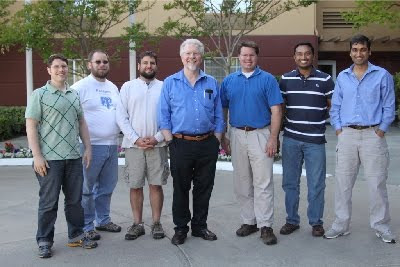
It was sunny outside but we ended up staying in the shade for better lighting balance. Other grads had to catch earlier flights home by the time this shot was taken.

GCaP grads 2010
Some graduates of the May 2010 GCaP class. Photo courtesy Manu M.

Here are some of the interesting topics that popped up in class discussions this week:This is why you too should consider attending an upcoming Guerrilla class.

Monday, June 1, 2009

Data + Models == Insight

Al Bundy, of the TV show Married with Children, understood it and performance engineers should too. What am I talking about? The theme music for that show is the tune "Love and Marriage" as sung by Frank Sinatra. Just like the song says about love and marriage, so it is with measurements and models ... You can't have one without the other.

Monday, April 20, 2009

Oracle Buys Sun Microsystems (Really!?)

I just read it (7am) and ... I'm speechless.

Thinks ....
  • Larry doesn't do hardware.
  • Decimation à la PeopleSoft?
  • Oracle still runs on IBM, and HP, et al.
  • Wherefore MySQL? Just a cheap shoehorn for the Oracle RDBMS?
  • Solaris (vs. Linux, which Oracle Corp has been pushing)? Ah! SMP scalability
  • And Java? (that made sense for IBM but...) Ah ha! Larry also owns Weblogic!
  • Can't think... Need coffee ...
  • Wait! What about OpenOffice? Oh oh!
Post café noir, this EETimes article seems to hit the salient points (modulo my JVM/Weblogic/J2EE observation). Update (April 24): The Oracle @cringely weighs in on the Sunset. [ He needs to read my blog. :) But he does have the IBM memo ]

Sunday, April 5, 2009

Forged in the USA

Little's law, Jackson's theorem, and JIT are concepts that we associate with computer performance analysis and capacity planning for IT systems. But the truth is, these ideas were forged while solving business and manufacturing problems. It's also true to say that both IT and manufacturing in the USA have suffered dramatically from the effects of rapid offshoring in the new global economy. In the past decade, 5 million manufacturing jobs have been eliminated in the USA.

Walmart is one of the few USA retailers that has managed to do reasonably well in this economic recession, because they (patriotically?) cut USA manufacturers loose in favor of setting up factories offshore; mostly in China. Indeed, if you look at the tags on the items in a Walmart store, you won't see Made in Anywhere USA. Instead, it's anywhere but USA. Or so it would seem.

This piece: Despite Job Loss, U.S. Manufacturing Still Leads , on NPR this morning, caught my attention when it was pointed out that the USA still ranks as the number one manufacturer, producing some 20% of all goods in the world, ahead of Japan and well ahead of China. The reason this appears to contradict simple observation (like looking at Walmart tags) is that manufacturing in the USA is two levels of indirection away. The USA manufactures things that manufacture things. In other words, USA companies make heavy equipment and machines that are used in factories and on assembly lines that make the goods we buy, and that's not stated on those Walmart tags. But that's where Little, Jackson and JIT came in.

Thursday, March 19, 2009

IBM Might Swallow the Sun


"Shares of Sun Microsystems, which makes the Java software that runs many Internet applications, were up 78.9 percent after reports that it was in talks to be acquired by I.B.M. Shares of Sun ended at $8.89. I.B.M. was down 1 percent, to $91.95."
I heard this rumor at the Portland CMG meeting yesterday. Apparently, Sun has been quietly "looking for a date" for some time. Presumably, IBM's main interest is in Java IP. Will Solaris replace AIX (under the covers)?

I had a long-standing theory that Sun Microsystems would be bought by Fujitsu Corp to simply milk Solaris service contracts for the next 10 years. It's not interesting innovation, but it is a business. Sun has always managed to have enough cash in the bank to be able to forestall such a move, but now, they're out of gas.

Update: Why an IBM purchase of Sun would make sense (cnet)

Saturday, May 3, 2008

Object, Time Thyself

For quite a while (6 years, to be exact), I've thought that the only sane way to address the problem of response-time decomposition across multi-tier distributed applications, is for the software components to be self-timing. In fact, I just found the following old email which shows that I first proposed this concept (publicly) at a CMG vendor session conducted by Rational Software (now part of IBM) in 2002:

Saturday, March 22, 2008

Corrigenda Available for GCaP Book

Looks like it's time to start a corrigenda page for my book, Guerrilla Capacity Planning: A Tactical Approach to Planning for Highly Scalable Applications and Services.

Special note added regarding J2EE/WebLogic listen threads in Chapter 7 and how they control application scalability.

You can submit an erratum online.